Retrospective Analysis: From 5 Monolithic Pipelines to 4-Layer Architecture
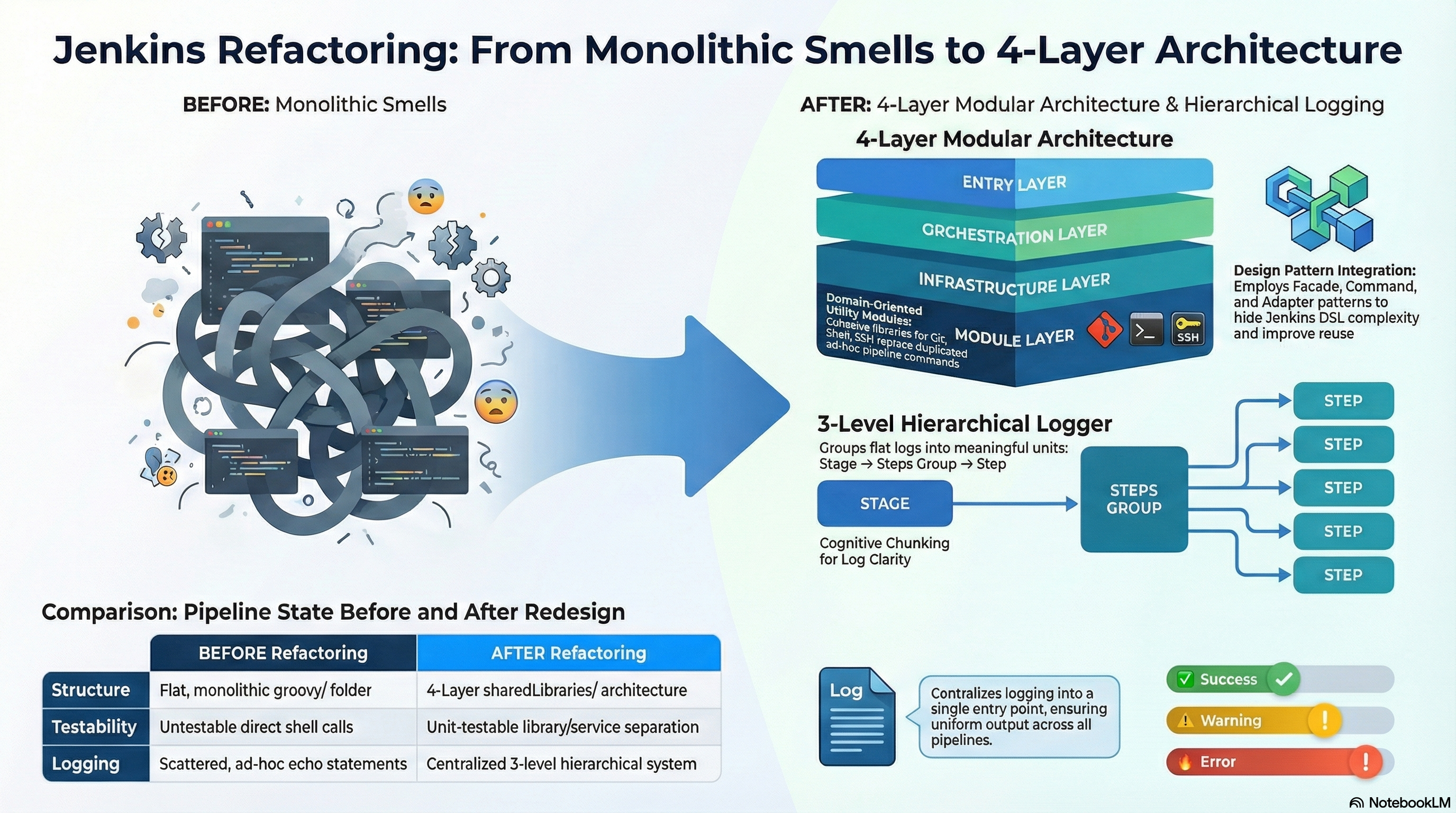
| What I did | Transformed 5 monolithic pipelines (41% duplication) into 4-layer architecture with centralized libraries |
| How it emerged | Felt the pain - organized by domain naturally - patterns emerged |
| Post-analysis | Mapped my solution to industry concepts (Software Smells, DDD patterns, GoF Design Patterns) |
| Documentation | Problem analysis, pattern identification, architecture rationale |
Note on 37% vs 41%: If you came from my resume, you may have seen "37% duplication." That figure was from an earlier baseline (
54479b2, 2025-02-21). After detailed commit history analysis,74fc356(2025-03-20) was identified as the accurate "before refactoring" state, showing 41% duplication. The increase itself demonstrates the architecture's High Viscosity problem.
Purpose
This portfolio is a post-refactoring analysis of intuitive problem-solving done during VARLab Co-op.
| What I Did | What This Document Does |
|---|---|
| Refactored 5 monolithic pipelines into 4-Layer Architecture | Classify and define those intuitive fixes using industry conventions |
| Designed 3-Level Logger System | Analyze why the design worked and how it integrates with the architecture |
Goal: Transform experience-based understanding into systematic, reusable knowledge
- Learn how problems I "felt" are formally named (Software Smells, Anti-patterns)
- Validate solutions against established principles (SOLID, Design Patterns)
- Understand integration points that made the Logger System possible
If I Had This Analysis Then...
Before (During Refactoring)
When I proposed this refactoring to my supervisor, I could only say:
"The code is messy. There's a lot of copy-paste. It's hard to maintain. I think we should restructure it."
I knew something was wrong. I felt the pain every time I had to modify multiple files for a single change. But I couldn't articulate why it was problematic or how bad it actually was.
After (With This Analysis)
If I had this analysis back then, I could have presented:
"We have 41% code duplication across 5 pipelines. A single change to
sendBuildStatusrequires modifications in 18 locations across 6 files. We're making 113 external calls to 12 different systems with no abstraction layer, making the code untestable. In the past month alone, duplication increased from 37% to 41%, showing the architecture's High Viscosity is causing duplication to grow naturally."
Instead of "it feels messy," I could have shown concrete numbers. Instead of "it's hard to maintain," I could have explained Shotgun Surgery with specific examples. Instead of "we should fix it," I could have demonstrated the ROI degradation where 10-minute tasks were taking hours.
The Difference
| Aspect | Before | After |
|---|---|---|
| Problem Description | "Code is messy" | "41% duplication, 18-location Shotgun Surgery" |
| Justification | "I feel it's hard to maintain" | "Duplication increased 4% in 1 month (High Viscosity)" |
| Scope | "A lot of copy-paste" | "113 external calls, 12 types, untestable" |
| Urgency | "We should fix it sometime" | "10-20 min tasks - hours, ROI degradation" |
This analysis transforms intuition into evidence. It provides the vocabulary and metrics needed to communicate technical debt to stakeholders who may not see the code daily.
What Would You Like to Know?
🔍 Problem Analysis
Q: Want to see how I analyzed a single file?
Analysis flow: Define SRP criteria - Analyze responsibility per function/module - Identify Software Smells
Q: Want the overall problem analysis summary?
Q: Want the detailed analysis?
- detailed-analysis.md - Synthesized findings (Symptoms, Patterns, Duplication)
- architecture-smells-analysis.md - System-level analysis
- DRY-violation-analysis.md - Cross-file duplication patterns
🛠️ Solution
Q: Want to see the final architecture and solution overview?
Q: Want to know which design principles were applied?
- solution-by-layer.md - 4-Layer Architecture analysis
- solution-by-feature.md - Logger System, Shell Libraries analysis
Q: Want the step-by-step implementation process?
- solution-overview.md - Phase 0~4 overview with links
📄 Supplement
Q: Want the DDD perspective analysis?
Q: Want to see the Pull Request documentation?
Project Overview
Background
- 14 months of accumulated Technical Debt
- 5 monolithic pipelines (41% duplication, untestable)
- Discovered Jenkins Global Trusted Shared Library feature at month 13
- Performed refactoring over 54 days (Library setup 35 days, Core refactoring ~2 weeks)
Timeline
| Milestone | Date | Commit | Repository |
|---|---|---|---|
| Initial commit (Windows) | 2023-12-17 | e9d8028 |
devops-jenkins-windows |
| Migration to Linux | 2025-01-07 | 5a59d45 |
devops-jenkins-linux |
| Baseline (Before refactoring) | 2025-03-20 | 74fc356 |
devops-jenkins-linux |
| Technical Debt Period | ~14 months | ||
| Refactoring complete | 2025-05-12 | ff74ac8 |
devops-jenkins-linux |
Repository started in Windows environment and migrated to Linux. Initial commit (2023-12-17) - Baseline (2025-03-20) = ~14 months of accumulated Technical Debt
Document Structure
retrospective-analysis-from-5-monolithic-pipelines-to-4-layer-architecture/
│
├── README.md                           # ← This document (entry point)
│
├── problem-analysis/                   # Problem Analysis
│   ├── problem-analysis-overview.md    # Problem summary (★ Start here)
│   ├── detailed-analysis.md            # Synthesized findings
│   ├── architecture-smells-analysis.md # System-level analysis
│   ├── DRY-violation-analysis.md       # Cross-file duplication
│   │
│   ├── 01-generalHelper/               # Per-file analysis
│   │   ├── 01-srp-violation-analysis.md
│   │   ├── 02-software-smells-analysis.md
│   │   └── 03-design-smells-symptoms.md
│   ├── 02-jsHelper/
│   ├── 03-unityHelper/
│   ├── 04~08-Jenkinsfiles/
│   │
│   └── pipeline-sequence-diagrams/     # Pipeline flow analysis
│       ├── domain-mapping.md
│       └── dlx-ci.md, dlx-cd.md, js-ci.md, js-cd.md, jenkins-ci.md
│
├── problem-solving/                    # Solution
│   ├── solution-overview.md            # Entry point for solution docs
│   ├── solution-by-layer.md            # 4-Layer Architecture analysis
│   ├── solution-by-feature.md          # Logger System, Shell Libraries
│   ├── logger-system-design-integration.md  # Logger design document
│   ├── domain-driven-analysis.md       # DDD analysis (supplement)
│   ├── pull-request-documentation.pdf  # PR attachment
│   └── phase-0~4/                      # Step-by-step changelogs
│
└── resources/                          # Images
    └── architecture-overview.png, stage-logger-*.png